
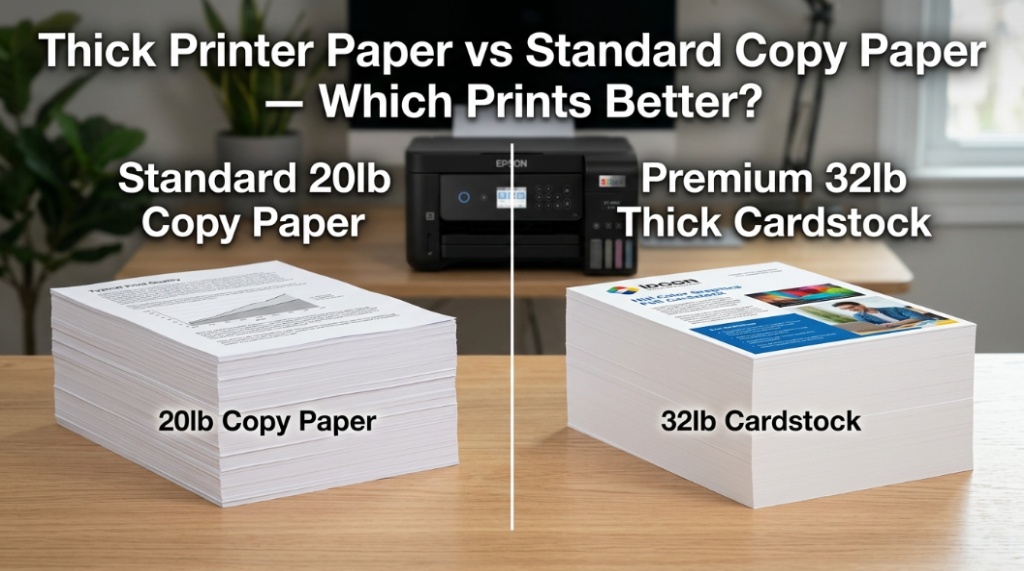
Paper jams ruin fewer print jobs than invisible ink absorption does. That is why thick printer paper vs standard copy paper matters more than most office buyers realize. Thick paper usually prints better for presentations, marketing sheets, certificates, photos, and premium business documents because it absorbs ink more evenly, reduces show-through, and delivers sharper color contrast. Standard copy paper remains better for high-volume everyday printing because it is cheaper, lighter, and faster for most office printers.
What Is Difference Between Thick Printer Paper And Standard Copy Paper?
Direct answer: Thick printer paper uses higher GSM or cardstock-style weight for stronger durability and better print quality, while standard copy paper is lighter, cheaper, and designed for everyday office use.
Most people only notice paper after a bad print result. Faded colors, curled pages, blurry graphics, ink bleeding, and printer jams often come from using the wrong paper type rather than poor printer settings.
Standard copy paper usually ranges between 70–90 GSM. Thick printer paper often starts around 100 GSM and can exceed 300 GSM depending on purpose. Paper thickness changes how toner or ink interacts with surface fibers.
For example:
- Resume printing often benefits from premium office paper
- Restaurant menus require thicker durability
- Presentation handouts look sharper on heavy matte sheets
- Photo prints demand coated thick paper
- Bulk school assignments work fine on standard copy paper
Businesses increasingly use heavier paper because physical branding still influences customer trust. According to marketing studies from print industry associations, premium-feel printed material can improve perceived brand quality and retention.
Which Paper Type Produces Better Print Quality?
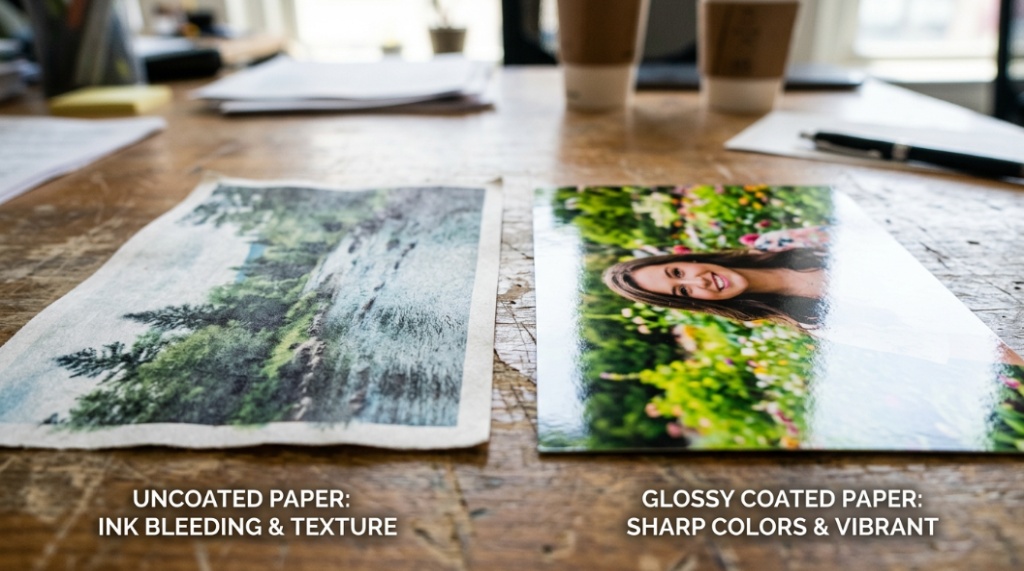
Direct answer: Thick printer paper generally produces sharper images, deeper colors, and cleaner text because heavier fibers absorb ink more evenly and resist bleeding.
Print quality depends on three major factors:
- Paper weight
- Paper coating
- Printer compatibility
Standard copy paper is porous and thin. Ink spreads faster into fibers, which can soften edges around letters and graphics. Thick paper typically offers tighter fiber construction, helping ink stay closer to surface level.
That difference becomes obvious during:
- Photo printing
- Brochure design
- Business card prototypes
- Presentation graphics
- Marketing flyers
Laser printers especially benefit from thicker stock because toner fuses more cleanly onto stable surfaces. Inkjet printers also produce richer gradients on premium office paper designed for photo or presentation output.
Does Thick Paper Improve Text Sharpness?
Direct answer: Yes. Thick paper often improves text clarity because it minimizes feathering and prevents excessive ink spread.
When tiny text prints onto thin copy paper, edges may appear fuzzy under close inspection. This matters for:
- Contracts
- Legal documents
- Academic reports
- Portfolio samples
- Luxury packaging inserts
Higher-quality paper maintains cleaner typography, especially with serif fonts and detailed charts.
Is Thick Printer Paper Same As Cardstock?
Direct answer: No. Thick printer paper and cardstock overlap in weight range, but cardstock is usually heavier, stiffer, and less flexible.
Many buyers search for a cardstock alternative because true cardstock may not run smoothly through standard home printers. Thick printer paper offers a middle-ground solution.
| Paper Type | Typical GSM | Flexibility | Best Use |
|---|---|---|---|
| Standard Copy Paper | 70–90 GSM | High | Daily office printing |
| Premium Office Paper | 100–120 GSM | Medium | Reports, resumes, presentations |
| Heavy Printer Paper | 120–170 GSM | Lower | Flyers, menus, brochures |
| Cardstock | 180–350 GSM | Very low | Cards, invitations, packaging |
For users wanting durability without full cardstock stiffness, 120–160 GSM paper often works best.
Can Every Printer Handle Thick Paper?
Direct answer: No. Some printers struggle with thick media, especially older inkjet models or compact office printers.
Before using thick sheets, check printer specifications. Most manufacturers publish supported paper weight ranges.
Common printer limitations include:
- Paper feed roller weakness
- Curved paper paths
- Heat limitations in laser printers
- Ink drying issues
Modern printers from companies like :contentReference[oaicite:0]{index=0}, :contentReference[oaicite:1]{index=1}, and :contentReference[oaicite:2]{index=2} often support thicker media through rear manual feed trays.
What GSM Is Safe For Home Printers?
Direct answer: Most home printers safely support 80–120 GSM paper, while many modern printers can handle up to 200 GSM using manual feed settings.
If paper is too thick:
- Pages may jam
- Toner may not bond correctly
- Ink may smear
- Rollers may slip
Always test a few sheets before bulk printing important material.
Why Does Thick Paper Feel More Premium?
Direct answer: Thick paper feels premium because humans associate weight, texture, and rigidity with higher quality and greater value.
Luxury brands rarely use thin copy paper for printed communication. Heavier stock creates stronger tactile feedback.
Psychology research in marketing consistently shows physical texture influences customer perception. Thick paper can make:
- Invoices look professional
- Resumes feel credible
- Menus appear upscale
- Certificates seem authentic
- Marketing materials gain attention
This explains why premium office paper remains common even in digital-first industries.
Does Thick Printer Paper Use More Ink?
Direct answer: Sometimes. Thick paper can absorb more ink depending on coating and fiber structure, but it often improves color efficiency and reduces bleeding.
Coated premium paper usually produces better saturation using less visible ink spread. Thin paper absorbs ink unpredictably, causing faded appearance and wasted coverage.
Ink usage depends on:
- Paper coating
- Printer type
- Color density
- Image complexity
- Print resolution settings
Photo-grade thick paper often maximizes visual quality even if ink usage rises slightly.
Does Thick Paper Dry Faster?
Direct answer: Not always. Some coated thick papers dry slower because ink remains closer to surface level.
Laser printers usually avoid this issue because toner fuses through heat rather than liquid absorption.
Which Paper Works Best For Double-Sided Printing?
Direct answer: Thick printer paper usually performs better for double-sided printing because it reduces show-through and page transparency.
Thin copy paper commonly allows shadows from reverse-side text to appear through front pages. This problem becomes worse with:
- Dark graphics
- Color-heavy documents
- Small fonts
- Dense layouts
Heavier paper improves readability and presentation quality.
Recommended weights for duplex printing:
- Office reports: 100 GSM
- Booklets: 120 GSM
- Brochures: 130–170 GSM
- Menus: 170+ GSM
Is Standard Copy Paper Better For Office Printing?
Direct answer: Yes. Standard copy paper remains best for high-volume office printing because it is affordable, lightweight, and optimized for speed.
Large offices print thousands of pages weekly. Using thick stock for every document would significantly increase:
- Printing costs
- Shipping weight
- Storage space
- Printer wear
- Paper jam frequency
Standard paper performs efficiently for:
- Internal documents
- Draft printing
- School assignments
- Invoices
- Daily reports
That balance between affordability and functionality explains why copy paper dominates workplace printing globally.
Which Paper Type Lasts Longer?
Direct answer: Thick paper generally lasts longer because it resists bending, tearing, and moisture damage better than standard copy paper.
Durability matters for documents handled repeatedly.
Examples include:
- Restaurant menus
- Certificates
- Training manuals
- Product catalogs
- Educational flashcards
Archival-quality premium office paper may also include acid-free construction, reducing yellowing over time.
Does Thick Paper Curl Less?
Direct answer: Usually yes. Heavier paper tends to resist curling because it maintains structural rigidity better during heat and moisture exposure.
Laser printers especially benefit from stable paper structure during high-temperature printing cycles.

What Is Best Paper For Photos And Marketing Material?
Direct answer: Thick coated paper delivers best results for photos, brochures, and promotional prints because it enhances color accuracy and contrast.
Marketing design relies heavily on visual impact. Thin paper weakens perceived quality immediately.
Businesses commonly choose:
- Glossy paper for vivid photos
- Matte paper for readable brochures
- Satin finishes for balanced reflection
- Heavyweight presentation paper for proposals
Commercial print shops rarely use standard copy paper for customer-facing marketing assets.
How Does Paper Weight Affect Printer Performance?
Direct answer: Paper weight directly affects feed reliability, ink absorption, print sharpness, and mechanical stress inside printers.
Light paper moves quickly through rollers but may wrinkle or misalign. Heavy paper improves stability but demands stronger feed mechanisms.
Printer engineers balance:
- Roller traction
- Heat distribution
- Paper curvature
- Drying time
- Output speed
Modern office printers increasingly support mixed-media workflows because businesses now produce more short-run marketing material internally.
Should You Buy Premium Office Paper For Everyday Use?
Direct answer: Usually no. Premium office paper is best reserved for client-facing, professional, or high-impact documents.
Using premium paper daily may not justify extra cost unless presentation quality matters.
Best situations for premium office paper:
- Job applications
- Client proposals
- Investor presentations
- Brand brochures
- Professional portfolios
Standard paper remains economically smarter for routine workflows.
Which Option Offers Better Value Long-Term?
Direct answer: Standard copy paper offers better cost efficiency, while thick paper offers better presentation value and durability.
Value depends entirely on purpose.
| Need | Best Choice |
|---|---|
| Bulk office printing | Standard copy paper |
| Professional presentation | Premium office paper |
| Flyers and brochures | Heavy printer paper |
| Certificates and menus | Thick paper |
| Budget-conscious printing | Standard paper |
| Cardstock alternative | Heavyweight printer paper |
The best strategy for many users is combining both paper types based on document purpose.
Conclusion: Which Prints Better?
Direct answer: Thick printer paper prints better for quality-focused projects, while standard copy paper remains best for speed and affordability.
Paper choice changes how people perceive your documents. Thin paper works perfectly for internal communication and bulk office tasks. But when visual quality, durability, and professionalism matter, thicker stock consistently delivers stronger results.
If you print resumes, business proposals, brochures, restaurant menus, marketing flyers, or presentation material, premium office paper creates noticeable improvements in clarity and tactile quality. It also serves as an effective cardstock alternative for many home and office printers.
At same time, standard copy paper remains essential because it keeps operational costs low and handles everyday workflows efficiently.
Smart printing is not about choosing one paper forever. It is about matching paper weight to purpose. That small adjustment can dramatically improve print results, customer perception, and document durability without changing printers at all.
Test multiple GSM options with your printer, compare results side by side, and choose paper based on actual document goals rather than price alone.
Frequently Asked Questions
Does thicker paper damage printers?
Direct answer: No, if paper weight stays within printer specifications. Problems usually happen when paper exceeds supported GSM limits.
Always check manufacturer guidelines before using heavyweight stock.
What paper weight feels professional for resumes?
Direct answer: Most professional resumes print best on 100–120 GSM premium office paper.
This range balances professionalism, readability, and printer compatibility.
Is thick paper better for inkjet printers?
Direct answer: Often yes, especially for photo or presentation printing.
However, coated thick paper designed specifically for inkjet use performs best.
Can standard copy paper print photos?
Direct answer: Yes, but image quality will usually appear duller and less detailed.
Photo paper or heavyweight coated sheets produce far superior results.
What GSM counts as cardstock alternative?
Direct answer: Paper between 120–170 GSM commonly works as practical cardstock alternative.
It provides durability without extreme stiffness.
Why does thin paper show ink through backside?
Direct answer: Thin paper allows light and ink density to pass through fibers more easily.
Heavier paper reduces transparency and improves double-sided readability.
Which paper type works best for brochures?
Direct answer: Brochures usually print best on 130–170 GSM coated paper.
This weight improves color vibrancy while maintaining fold flexibility.
📌 Related Reads
Discover: Cheap Bulk Printer Paper Deals Worth Buying
Explore: How to Strengthen Your Business with Adaptability and Innovation Techniques